

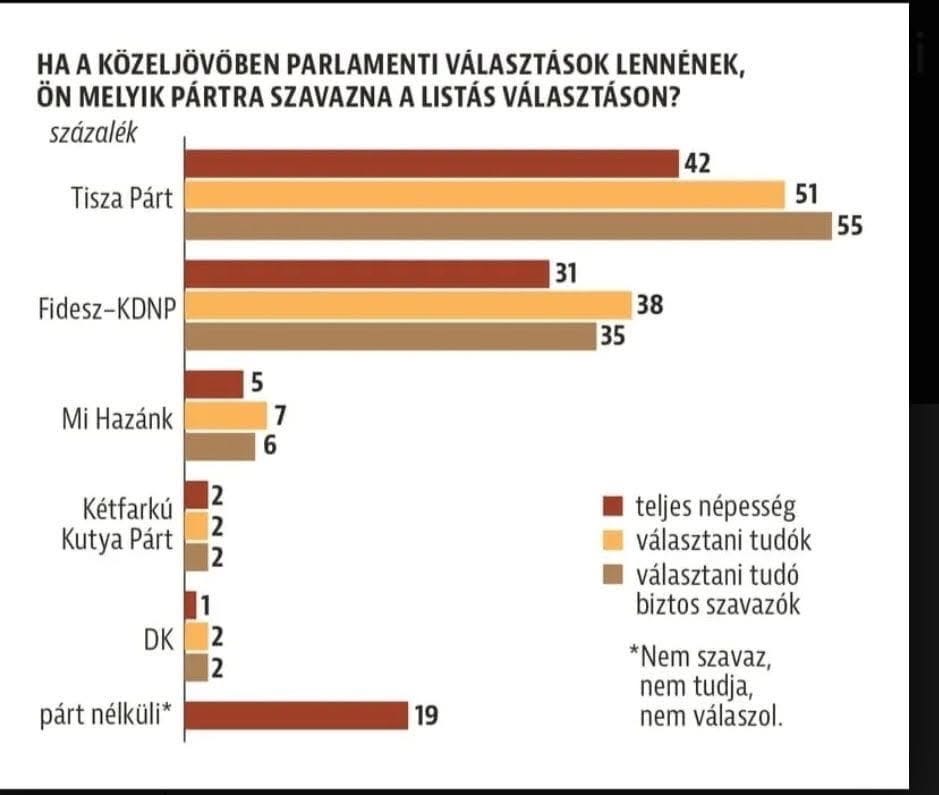
On Wednesday, the polling firm Medián published numbers that must have landed in Fidesz headquarters like a bucket of ice water. The Tisza Party now leads Fidesz by 11 percentage points among the entire voting-age population, and by a staggering 20 points – 55% to 35% – among decided voters. That gap has widened by 8 percentage points since January alone, as Tisza gained and Fidesz lost ground simultaneously. Medián has one of the strongest forecasting track records in Hungary – it correctly called Orbán’s landslide in 2022.
Hours later, Viktor Orbán convened the Defence Council and announced that Ukraine was planning attacks on Hungary’s energy infrastructure. He deployed troops to power plants and distribution stations, and banned drone flights along the Ukrainian border.
The sequence is the story.
There is no credible evidence of any Ukrainian threat. There has been no attack, no credible intelligence made public, no corroborating assessment from any allied government or NATO body. What there is, is a governing party staring into an electoral abyss and reaching for the one tool that has reliably worked before: manufactured fear. One can only speculate about what Fidesz’s own internal polling shows – but the scale of the response and the evident panic behind it suggest it may not look very different from Medián’s.
For background on the broader political situation ahead of April’s vote, see my earlier piece: Orbán’s Final Countdown – 12 Weeks to Go
The Pretext
The nominal backdrop is the shutdown of the Druzhba pipeline, which has been out of commission since 27 January. Ukrainian officials have stated that the pipeline was hit in a Russian drone attack, and that repairs are hazardous because it can only operate reliably if Russia stops targeting Ukrainian energy infrastructure. Orbán’s response has been to blame Ukraine – and to escalate that blame, week by week, into the language of sabotage and imminent attack.
The reversal is worth noting. Just four days earlier, on 22 February, Orbán convened the National Energy Security Council and told Hungarians the exact opposite: “We have eliminated this danger, made appropriate decisions, so today there is no threat to the security of supply in Hungary. Uninterrupted, normal functioning of the country is ensured.” Within 96 hours, that reassurance had been discarded and replaced with troops at power stations and talk of imminent enemy sabotage. Nothing changed on the ground. What changed was the Medián poll.
The framing is not accidental. Orbán has in recent weeks launched an aggressive anti-Ukraine campaign ahead of elections in April, which will likely be the toughest he has faced in his 16 years in power. Fidesz has pushed the message that if it loses, the opposition will drag Hungary into the war in Ukraine, bankrupting the country and getting its youth killed on the front lines. The pipeline dispute provides a ready-made stage for that narrative.
The False-Flag Playbook
Look at the specific character of Wednesday’s announcement. Orbán did not claim that an attack had occurred. He claimed that Ukraine is “preparing” one. He deployed military assets to infrastructure sites on the basis of alleged intelligence about future sabotage. He banned drone flights across an entire border county.
This is a well-established authoritarian pattern. You do not need an actual incident. You need a *credible threat environment* – one that justifies emergency measures, saturates the media with security imagery, and repositions the government as the sole guarantor of national survival.
The question that must be asked directly: could the threat be manufactured? Could a staged incident – an explosion at an energy facility, a drone shot down near the border, a “Ukrainian saboteur” arrested – be engineered and then pinned on Kyiv, with Russian assistance?
The precedent is not abstract. When Russia launched its full-scale invasion of Ukraine in February 2022, the rally-round-the-flag effect was immediate and powerful. Orbán went on to win 54% of the vote that April – his highest share since 1990, in an election held just weeks after the invasion, when fear was at its peak and the opposition had been successfully cast as a security risk.
He will not win 54% in April 2026. Not with these polls. But with a sufficiently acute security crisis in the weeks before election day – one that can be blamed on Ukraine and framed as proof of the opposition’s dangerous naivety – the calculus changes.
The More Extreme Scenario
There is a harder question that must at least be named, even if we hope it does not materialise.
What if the polls do not move? What if, even with a manufactured security crisis, Orbán cannot close a 20-point gap in seven weeks? What tools remain?
Hungary’s constitution does not currently provide a mechanism to postpone elections. But Orbán’s governments have demonstrated repeatedly that constitutional constraints are malleable when you control parliament with a two-thirds majority. A sufficiently grave declared security emergency – a “terrorist attack” on energy infrastructure, perhaps one with evidence carefully pointing toward Ukraine – could create political cover for extraordinary measures that would have seemed unthinkable even a year ago.
This is not a prediction. It is a risk assessment. And it is one that democratic observers inside and outside Hungary need to be making openly right now, before such a scenario unfolds – not after.
What Russia Gets from This
This is not, it should be stressed, a novel playbook. It is Putin’s own. In 1999, a series of apartment block bombings killed nearly 300 Russian civilians, were blamed on Chechen rebels, and catapulted an obscure FSB director into the presidency. The evidence that the attacks were a false-flag operation organised by the FSB itself is, as historian David Satter has argued at length, “overwhelming” – a conclusion also reached in the most thorough academic study of the bombings to date. A man who staged terror attacks against his own people to win an election has every reason to help his most reliable European vassal do something considerably less demanding.
Moscow’s interests here are perfectly legible. A staged or Russian-facilitated incident on Hungarian infrastructure – plausibly attributed to Ukraine – would simultaneously keep the Druzhba grievance narrative alive, provide propaganda for the Russian claim that Ukraine is an aggressor state, and potentially preserve in power Europe’s most dependable Kremlin apologist at the precise moment when Hungarian voters are poised to remove him. The operational requirements would be modest. Russian intelligence has deep roots in Hungary. The public has been primed for weeks to accept the idea of Ukrainian energy hostility. The pretext has been constructed carefully.
As RBC Ukraine noted, the European Commission has reportedly toned down public criticism of Orbán to avoid giving him grounds to claim EU interference in the election campaign. That restraint is understandable – but it may be precisely the wrong response to what is now unfolding.
## The Responsibility of EU Governments – and the Time to Act Is Now
This is where European institutions and member-state governments bear direct responsibility – and where silence or ambiguity would be a serious failure.
The European Commission and EU governments should be stating clearly, right now and in public, that any postponement or suspension of Hungary’s April 12 elections will not be recognised, that emergency declarations used to curtail political activity or restrict the campaign will be treated as an authoritarian breach of EU foundational values, and that any “terrorist incident” conveniently implicating Ukraine will face immediate independent international scrutiny before a single diplomatic or legal consequence follows.
The point of making this clear now – before any incident, not after – is precisely to deny Orbán the political space to execute the manoeuvre. If he knows that Brussels and Berlin and Paris are watching, that staged violence will not buy him emergency powers or a postponed election but instead trigger Article 7 proceedings and immediate political isolation, the calculus shifts. Autocrats are not irrational; they respond to costs.
The Hungarian people are, for the first time in sixteen years, genuinely positioned to end the Orbán system through the ballot box. The regime knows this. With 97% of Tisza supporters certain to vote, against only 85% of Fidesz supporters, even the turnout arithmetic is working against it. A 20-point deficit in seven weeks is not a gap you close with policy announcements.
You close it with a crisis. Or you manufacture one.
EU governments know how this playbook works. They have watched it deployed across the region for years. The question is whether they will act on that knowledge in time to matter – or whether they will, once again, respond to events rather than shape them.
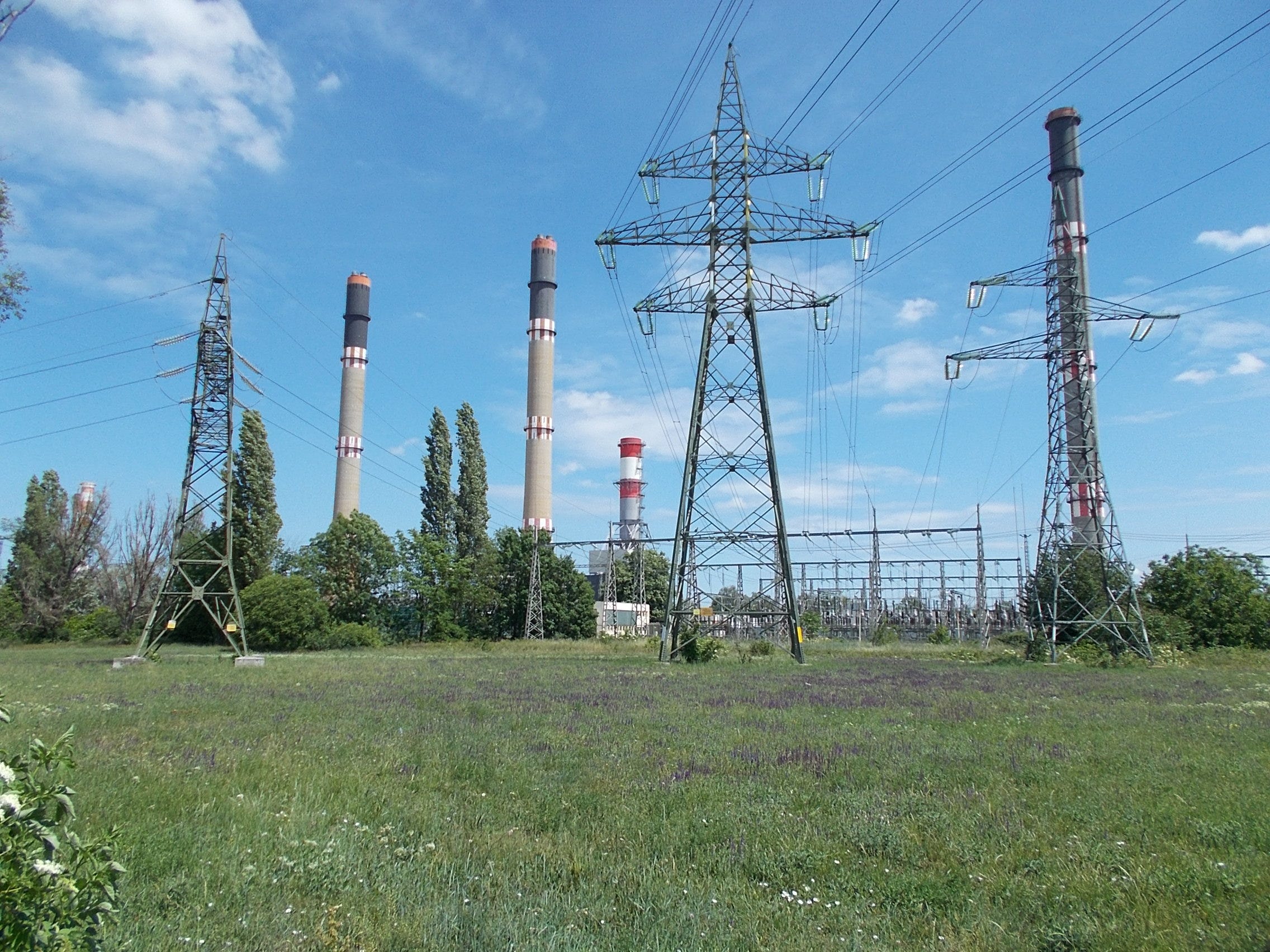
Photo: Dunamenti Power Plant, chimneys, electric pylons from Erőmű Road, Százhalombatta, Pest County, Hungary. CC BY-SA 3.0 by Globetrotter19 on WikiMedia Commons

-,Globetrotter19,-(talk%20%7C)
The horror show of security theater